Showing posts with label Sigur Center. Show all posts

Sunday, August 27, 2017

VLOG #4: Final Remarks

Hello! My little tripod stand broke during traveling so the set up of this blog is very close to my face. Hope you don't mind the close up.
Thanks again the the Sigur Center for allowing me to experience a wonderful three months in Taiwan. My time here will be unforgettable.

Tracie M. Yang M.A Asian Studies, Class of 2018
Sigur Center 2017, Asian Language Fellow
National Taiwan Normal University, Taipei, Taiwan (ROC)
President, Organization of Asian Studies (OAS)

VLOG #3 Taiwanese Cuisine


Tracie M. Yang M.A Asian Studies, Class of 2018
Sigur Center 2017, Asian Language Fellow
National Taiwan Normal University, Taipei, Taiwan (ROC)
President, Organization of Asian Studies (OAS)

Friday, August 18, 2017

Final thoughts from Taiwan

Hey all, this is my final blog post from Taiwan. I have now been in Tainan, Taiwan for eight weeks; I wish that I didn't have to leave so soon! I have grown quite accustomed to the pace of life here and, more importantly, I will be sad to part with my amazing teachers and classmates. My experience in Taiwan has been overwhelmingly positive.

A view of Taipei from Jiantan mountain.

Looking back, it is satisfying to think about just how much my Chinese has improved. When I first arrived, I struggled to hold even basic conversations with my teachers and local friends. These days, I can easily chat about a wide range of topics -- albeit with the occasional English word peppered in for the sake of fluency. I sometimes even catch myself having to translate Chinese thoughts into English sentences and, when I am texting/messaging non-Chinese speakers, I have to remind myself to not type in Chinese -- my natural instinct.

My program -- the American Councils Taiwan Intensive Summer Language Program at National Cheng Kung University -- advertised that we would learn one year's worth of Chinese in eight weeks. I feel as if I have improved so much that I would be unsurprised to find out that I learned more than a year's worth of Chinese!

A field on the outskirts of Taipei.
Moreover, as someone interested in cross-strait relations, spending my summer in Taiwan was invaluable. Though I lived in China for three years while growing up, I am comfortable admitting that prior to my time in Taiwan, my understanding of the cross-strait issue was flawed. I now firmly believe that experience living in both the mainland and Taiwan is essential for the development of a nuanced perspective.

I am excited to take all that I have learned in Taiwan and apply it to my studies, internship, research, and of course, my job at the Sigur Center!

Zachary Haver is a Sigur Center 2017 Asian Language Fellow. A rising sophomore studying at George Washington University's Elliott School of International Affairs, Zachary is majoring in International Affairs with a concentration in Asia and minoring in Mandarin Chinese.

Friday, August 11, 2017

Thoughts on National Taiwan University's International Chinese Language Program

My time in Taiwan has drawn to a close. I want to take a moment to review my time studying at National Taiwan University. While the International Chinese Language Program is widely renowned, I do have a few critiques. I would like to preface my review by saying just that, it is my personal review. It does not represent the experiences of all students in the program, but I have talked to many students in the program who shared my views.

ICLP advertises an immersive environment to study Mandarin Chinese. The program also offers students individualized study plans with small class sizes (2-4 students), with an additional one-on-one class tailored to your specific interests and difficulties you face in learning Chinese. Unfortunately, from my own experiences and those of other students, ICLP’s benefits seem to end there.

The following are a few of my frustrations and disappointments with my study abroad experience at ICLP.

  • ·        The program is advertised as an intense immersion program. In reality, teachers struggle to enforce this. This was disappointing for me. My classmates would often use English in class, with little to no comment from our teachers. This does not seem that problematic, but this undermined the benefits of an immersion program which is designed to expand students’ vocabulary and improve their communication skills at a faster rate.

  • ·        When students first arrive at ICLP, they are told that attendance is also critical. Students are only allowed to miss five classes throughout the summer. If a student misses more than 5 classes, they will not receive their certificate of completion at the end of the program. Extreme absence could result in dismissal from the program all together. Timeliness is also critical. Students who come to class over ten minutes late are expected to seek approval from the head office before entering the classroom. Neither attendance or timeliness are enforced, which I found to disrupt class schedules and interaction between teachers and students in general. I was in a morning class with one other student, and an afternoon class with only two other students. My classmate from my morning class was also in my afternoon class. This student missed nearly 4 or 5 classes a week! I spent many of my mornings alone with my professor. When the student would decide to attend class, they would arrive 10 or 15 minutes late. They would barge into the class, disrupting the lesson. On days the student skipped class, my teachers would either cancel the planned lesson or spend the first 15 minutes of class staring at the clock or making small talk with me. I can’t imagine how much more I could have learned had the ICLP teachers and administrators enforced their original expectations, or held students to higher standards of accountability.

  • ·        Let’s talk about the cost of attendance. ICLP is by far the most expensive Chinese language program in Taiwan, if not in all of Asia. For me, as for many students, the cost is not worth it. There are many other programs that offer great learning environments for a third, fourth, or even fifth of the cost. Even your books are not included in the program’s tuition! Many ICLP students had no additional funds to travel around Taiwan, or even explore Taipei. This was very disappointing. Considering the high cost of attending ICLP, many students wrongly assumed the program would provide opportunities for cultural excursions at no additional cost. Nope. Every additional outing was an extra cost for students. Although I had hoped to explore more of Taiwan this summer, I could not afford ICLP’s planned trips. Luckily, I had the opportunity to travel extensively around Taiwan when I studied in Tainan. But for students travelling to Taiwan for the first time hoping to explore the island, ICLP is not for you.

  • ·        My final frustration with ICLP involves the structure of classes. Chinese is notorious for being one of the most difficult languages to learn. With that in mind, you would assume teachers would prefer to guide students’ learning. This is not how it played out for my classes. I was asked to turn in assignments prior to finishing, or even beginning a lesson. I did not have a problem doing the work, but this schedule forced me to teach myself a language I have struggled to master for years. A result of this method is students failing to learn how to appropriately use specific grammar structures or vocabulary. Doing homework before learning a lesson reinforces misconceptions and disrupted my learning process. Also, I felt like I paid a great deal of money to teach myself all summer. Very disappointing.
I made great friends at ICLP and my Chinese improved over the summer, but overall, I felt the program did not live up to its reputation. All I can say is you do not always get what you pay for.

Katelyn DeNap

George Washington University - Elliott School of International Affairs
M.A. Security Policy Studies
Organization of Asian Studies – Vice President
Sigur Center 2017 Asian Language Fellow

National Taiwan University - International Chinese Language Program, Taiwan

Another update from Taiwan

My second vlog! In this segment, I talk about a particularly memorable experience in Taipei.


Zachary Haver is a Sigur Center 2017 Asian Language Fellow. A rising sophomore studying at George Washington University's Elliott School of International Affairs, Zachary is majoring in International Affairs with a concentration in Asia and minoring in Mandarin Chinese.

Wednesday, August 9, 2017

Typhoon Preparedness

Typhoon season is upon us all studying abroad in Taiwan! So, for those of you considering travelling to the island in the future, I would like to provide a few tips for surviving the storm.

1.       While not all typhoons are equally severe, treat each as if they were capable of equal damage. Typhoons can take you by surprise. Do not disregard the countless warnings you will receive from weather services and government offices. A typhoon is called a typhoon for a reason. The rains and wind that accompany this type of storm far exceed the usual rainy summer afternoon in Taiwan.

2.       With this in mind, DO NOT go outside during a typhoon unless absolutely necessary. And, make every effort to be safely indoors before one arrives. This past week, my friend and I had dinner plans on Saturday night. We were aware a typhoon was coming, but the rainfall throughout the day had been minimal. We wrongly assumed the typhoon had developed weaker than originally predicted by meteorologists. While we had dinner, we were unaware of the storm brewing outside. By the time we were heading home, the typhoon was in full force. Our umbrellas were rendered useless by the extreme wind and rain falling at a 45-degree angle. We nearly did not make it home, fighting the wind the whole way. We learned our lesson, and chose to hunker down indoors for the remainder of the storm.

3.       So how do you survive typhoon inflicted house arrest? RAMEN! While I use typhoons to justify my unhealthy desire for these cheap and incredibly unhealthy instant meals, any food that requires little to no preparation is great. Be prepared for potential power outages. I would also advise you to buy bottled drinks in case you lose access to clean water. If the typhoon is expected to last a few days, I suggest you buy prepackaged milk tea to prevent withdrawals!

4.       Hopefully you can ride out the typhoon with a friend, but if not, be sure to grab a good book and some movies to pass the time!

For those of you staying in Taiwan currently and those planning a to study abroad here in the future, have fun, but be safe!

Katelyn DeNap

George Washington University - Elliott School of International Affairs
M.A. Security Policy Studies
Organization of Asian Studies – Vice President
Sigur Center 2017 Asian Language Fellow

National Taiwan University - International Chinese Language Program, Taiwan

Saturday, August 5, 2017

National Taiwan Normal University's Mandarin Training Center

My experience at the Mandarin Training Center.


National Taiwan Normal University’s Mandarin Training Center (MTC) is one of the oldest language learning institutions in Taiwan. Founded in 1956, it’s program has attracted students from all around the world to study. In my two and half months studying at MTC, I can honestly say that I have been very satisfied with my experience. Not only have I greatly accelerated my language skills, but I have also connected with students from all around the world.

Personally there were two main reasons as to why I made my decision to apply to the Mandarin Training Center at National Taiwan Normal University. One, the array of courses the program offers to it’s students and the diversity of the students. After doing some extensive research, I had been struggling between the Mandarin Training Center and National Taiwan University’s International Chinese Language Program (ICLP). After learning that students MTC comprised of students from all over Asia, Europe and Africa I was instantly sold. More importantly, as a heritage speaker the program at NTNU offers courses that are specifically geared towards students whose listening and speaking skills are advanced but reading skills are at the intermediate or beginner level. Naturally, upon enrolling in MTC I was placed into such a particular course. 

Currently I am in the intensive level program, a three month, three hour course that meets Monday through Friday. Although the work load can be a bit daunting the intensive course is well worth your time and money. The curriculum is fundamental and practical. Initially I was a bit daunted at the prospect of learning traditional Chinese characters. However, I have found that learning the historical context of each character and the radicals are really beneficial to memorizing the characters. Learning simplified Chinese may seem easier, but since the characters have been simplified to it’s base components the true context and meaning of the text is hard to remember and understand. Although it learning traditional Chinese writing seems arduous and daunting I think it is definitely worth it! 

Not only have I seen a great level of improvement in my reading and writing skills, but I have also made great connections with my classmates. Although we are all heritage speakers our class comes from an array countries with unique backgrounds. Within my class we have students from Japan, Thailand, Malaysia and South Africa. It has been quite fascinating to hear the perspectives of my classmates who all have similar but unique stories on how and why their families immigrated to different parts of the world. 

Overall, I have really enjoyed my time at the Mandarin Training Center. If you are a perspective student I would highly recommend the intensive program as the course that yields the best results! 

Tracie M. Yang M.A Asian Studies, Class of 2018
Sigur Center 2017, Asian Language Fellow
National Taiwan Normal University, Taipei, Taiwan (ROC)
President, Organization of Asian Studies (OAS)

Sunday, July 30, 2017

An update from Taiwan

Finally got around to uploading my first vlog! My thoughts on studying Chinese in Taiwan:


Zachary Haver is a Sigur Center 2017 Asian Language Fellow. A rising sophomore studying at George Washington University's Elliott School of International Affairs, Zachary is majoring in International Affairs with a concentration in Asia and minoring in Mandarin Chinese.

Friday, July 28, 2017

Studying Mandarin in Taiwan: A lesson in cultural and historical perspective.


Having a neighbor like China (The People's Republic of China) it is easy to overlook the thriving island state of Taiwan (The Republic of China). It is only recently, after living abroad in China, that I have come to understand the subtle yet significant differences between political and cultural identities between Taiwan and China. Oddly enough, this epiphany was brought about from attempting to understand my father’s fixation on the Civil War. Yeah, I am not talking about the civil war that took place in China...
Since I was little, I can remember my father’s fascination with the American Civil War. Given the opportunity, my dad would drag me to as many reenactments as he could. While there, my father would tell me about the gallantry of the Confederate soldier and take countless pictures with them. My father’s interest in the Confederates and the American Civil War was always a bit curious and bizarre. Not only because we lived in Southern California, far from any meaningful Civil War history, but also because my father is Chinese.
I grew up associating the Confederate South with ignorance and racial intolerance. So why was my father, a first generation Chinese immigrant, romanticizing their cause and defeat? I finally understood why when my father told me the story of his family’s arduous escape from Mainland China to Taiwan in 1949. He told me about his grandfather’s attempt to relocate his entire university student body from China, and of the number of casualties they endured during their journey. From then on, I had a better understanding of why my father held such an interest in the Confederate South. During my years of berating my father about his “Southern sympathies,” I had failed to consider how identity could play a part in my father’s historical perspective. I had failed to consider that my father’s romanticized views of a defeated group of people were a product of being a boy born into a family of refugees who had supported the losing side of a bloody civil war.  Since this revelation, I have endeavored to understand and experience the different cultural, historical and political perspective of China and Taiwan.
Most notably, I have found that language has been a great way of analyzing these differences.
In my second year living and working in the China I had naively thought that my understanding of Chinese culture and Mandarin would equally translate while traveling to Taiwan for a short Lunar New Year excursion. However, upon arriving in Taipei and meeting my distant family members, I had quickly realized that the language, the culture, and the people were far different from what I have seen and experienced in China. It was then that I came to the understanding that despite having a grasp of the language that both nations shared, I was naive to the fact that simply knowing Chinese Mandarin did not make me fluent in Taiwanese Mandarin, or the linguistic system shared by the Taiwanese people. After my short time in Taiwan, I had become fascinated by how the people’s use of traditional Chinese characters, their colloquialisms, the culinary culture, popular media and film, and their politics were all characteristics that helped encompass a unique Taiwanese identity.

So far my time here in Taipei, Taiwan has allowed me to really immerse myself in the lifestyle and history of the island. In my next posts, I hope to highlight the main aspects of Taiwan's distinctive political, historical and cultural perspective!

Tracie M. Yang M.A Asian Studies, Class of 2018
Sigur Center 2017, Asian Language Fellow
National Taiwan Normal University, Taipei, Taiwan (ROC)
President, Organization of Asian Studies (OAS)


Thursday, July 27, 2017

2 Months in Taipei, Taiwan (Vlog 2)


Hello again! It is my last day here in Taiwan, time just flew by. I am so thankful for the Sigur Center for giving me this amazing opportunity to learn more about Taiwanese culture, study Mandarin, and explore new parts of the world. This last video is a collection of my videos from throughout my time here in Taiwan, enjoy!


-Erin Mulhearn


Tuesday, July 11, 2017

2 Months in Taipei, Taiwan


Hello everyone! My name is Erin Mulhearn and I was fortunate enough to receive a grant to learn Mandarin in Taiwan this summer. Its been five weeks since I arrived in Taipei and I am absolutely loving it so far. I am studying at a small language school in the Zhongzheng district called Taiwan Mandarin Institute (TMI). The classes are very small, mine only has three including myself, so I feel like I am learning at a more intimate level. 

Before coming to Taiwan I had a very limited knowledge of the language, I only knew how to introduce myself and a few various words about food. One month into the program, I feel that my Mandarin has improved immensely. Firstly, I knew that Mandarin was a tonal language but I didn't realize the extent to which the tones matter. For example the pinyin for buy is mǎi with the third tone, however the pinyin for sell is also mài with the forth tone. Because English is not a tonal language learning the differences between the tones has been very difficult. 

Secondly, here in Taiwan the people use traditional writing instead of simplified that is used in mainland China. I already knew the writing was difficult but traditional writing is even harder than the simplified writing that I have seen before. However, this was one of the reasons why I chose to study in Taiwan over China, most of the meaning of the word is lost in the transition from traditional to simplified. For example the character for love in traditional is 愛 with the character for heart (心) inside. This is much different from the simplified as the character for heart is removed an written as 爱. In the transition from traditional to simplified the heart was removed from love which I think removes a lot of the meaning as well.


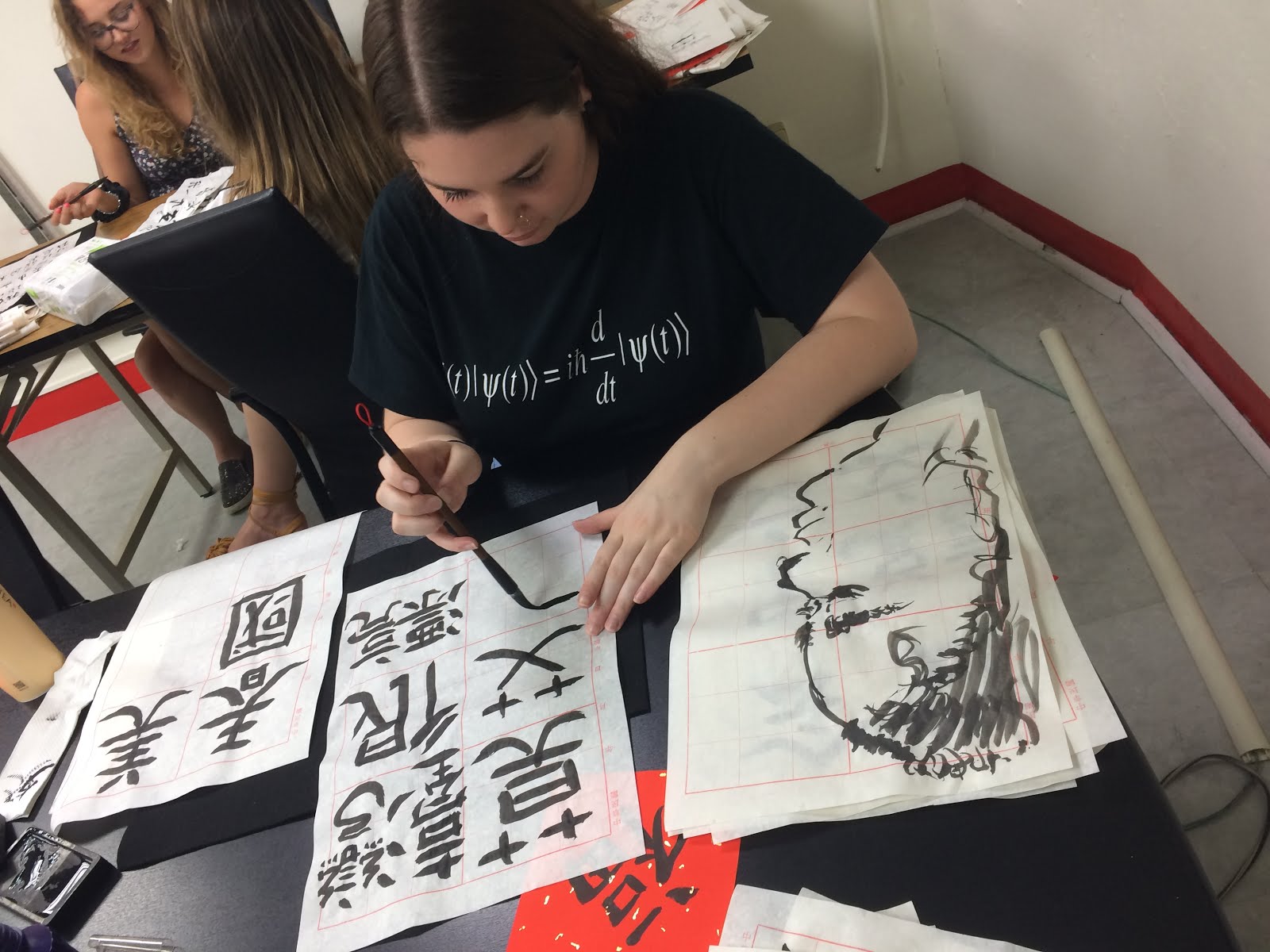
Practicing calligraphy (書法) at the school 


Being forced to actually speak the language to survive is making leaning the language even easier and its great practice. One of the things that I noticed right away is how nice the locals are here. Whenever I order food everyone asks where I am from, why I'm here in Taiwan, and if I mispronounce a tone they will correct it and have me repeat so I can learn. Taipei is a great city filled with history and culture but I've only experienced a fraction of what it has to offer so far. 

Chiang Kai Shek Memorial (中正紀念堂)
The view of Taipei 101 from Elephant Mountain (像山)
(慈祐宮) Ciyou Temple outside Raohe Night Market