Showing posts with label 2013. Show all posts

Monday, December 9, 2013

South Asia Summer Language Institute Applications are Open

Schedule & Coursework
All SASLI classes take place during the eight-week summer session from June 16- August 8. Classroom instruction will be scheduled for four hours a day, Monday through Friday. All SASLI students are expected to attend class daily. Students registering for SASLI are required to choose one South Asian language at either the elementary or intermediate level. Language offered include:Bengali, Gujarati, Hindi, Malayalam, Marathi, Pashto, Sanskrit, Sindhi, Sinhala, Tamil, Telugu, Tibetan, and Urdu.

Credits
The schedule will enable students to complete two intensive semester courses (equivalent to one academic year of study). Students will receive a total of 8 credits from the University of Wisconsin – Madison for the SASLI summer session.

SASh Program Fee
Invoices will be issued from the University of Wisconsin-Madison Bursar’s office and should be paid in full by the deadline. Please see the SASLI website for the current program fee. The fee does not include text books or living expenses. Housing & Living Costs SASLI students will be responsible for making their own living arrangements in Madison for the duration of the summer session. Students are also responsible for all living costs incurred during their stay in Madison. Please refer to the SASLI website for local housing links and information on summer dorms.

Fee Remissions
All applicants who submit a complete SASLI application are eligible to receive a $1000 Fee
Remission. There are some restrictions on combined funding. See the SASLI website for more information.

Fellowships
Foreign Language and Area Studies Fellowships (FLAS), provided by the U.S. Department of Education, are available to current and prospective graduate students who wish to attend SASLI. For information on the procedures and deadlines for FLAS applications at their home institutions, students should contact their local advisors. For students in institutions that do not offer FLAS, please see the SASLI website for more funding information.

SASLI Scholarship
A limited number of full or partial Scholarships are available for the summer session. See the SASLI website for application materials and information.

Application
Students must apply for admission to the SASLI program online via the SASLI web site. Please note that there is a nonrefundable application fee. For more information on deadlines and application procedures, see the SASLI website. The deadline is April 1.


www.sasli.wisc.edu

University of Wisconsin-Madison
203 Ingram Hall
115 Observatory Drive
608-261-1194

Tuesday, October 1, 2013

Site Visit to IFES (International Foundation for Electoral Systems)

The Graduate Student Career Development still has room available for its upcoming site visit to IFES (International Foundation for Electoral Systems) on Friday, October 4. IFES is actively recruiting for internships and full-time positions. It is not too late to RSVP, but there are only a few spots left!

The International Foundation for Electoral Systems (IFES) is an international, non-profit organization that supports citizens’ right to participate in free and fair elections. As the global leader in democracy promotion, IFES advances good governance and democratic rights by: providing technical assistance to election officials, empowering the underrepresented, and applying field-based research to improve the electoral cycle. Since being founded in 1987, IFES has worked in over 135 countries – from developing to mature democracies.

For more information, or to RSVP:
please log into Elliott School Career Connection: (http://www.elliottschoolcc.com).

Monday, August 26, 2013

Touristy in Seoul

Hi Asia on E Street Reader!

This is Selina once again :) I realize that I have yet to post about all the fun touristy things to do in Seoul. Here I will highlight some of the beautiful places to visit! And if you're ever in Seoul, I highly advise visiting these places!


I found that I got really in tune with nature throughout this trip. Above is a shot of the Secret Garden (Biwon) within Changdeokgung Palace. Having visited all the palaces in Seoul, I think this was the most beautiful of them all. 


 As a seafood lover, this was one of my favorite places! When my mom was still with me in Seoul, it was the only place she visited twice! Above is Noryangjin Fish Market. Its one of the largest seafood markets in Seoul. What's cool is that you go around the market and pick your fare. I got fresh fish which could be cut up into sashimi, shrimp to be grilled, and octopus raw. Having watched the Korean Movie Old Boy, I had to try raw octopus! Unlike the movie, they do cut it up! Though I can't guarantee that it will not continue to squirm. 

Raw Octopus called Sanakkji (산낙지)


In front of the National History Museum of Korea. Entering the lobby, it felt like it could fit in two Smithsonian Museums. Below is a pillar from one of teh exhibits. From behind you can see the explanation as a kind of height check.


Cosplaying Lee Soon Shin, A Joseon Dynasty Naval Commander

In Changdeokgung Palace.
Eating what the Royal family would eat during the Joseon Dynasty at Korea House.

By Kimchi pots within the Korea House Dynasty. This particular spot is famous for being the backdrop of some famous Korean Dramas.
By Cheongyecheon Stream. a massive urban developed stream that flows through the heart of Seoul.  


At Yangneyongsi Market, the oldest traditional oriental medicine market. You can find all sorts of things here. I even bought medicine to prevent balding for my cousins. 

In front of Gwanghwamun, the largest Palace in Seoul and located right in front of the statues of King Sejong and Lee Soonshin

Trying on a hanbok, the traditional Korean Dress at Namangol Hanok Village

On the way to the cable car to Namsan Tower. 
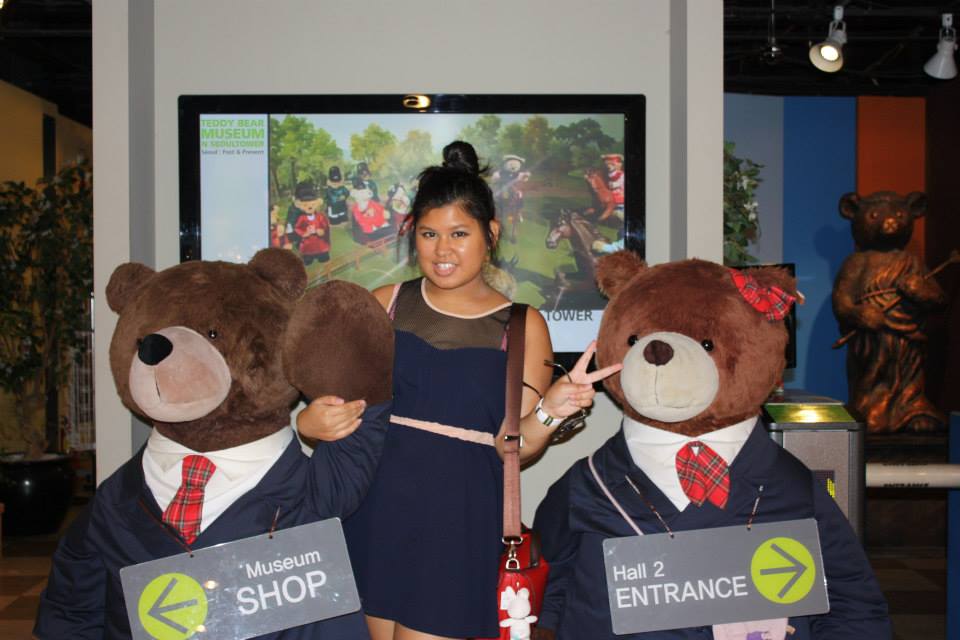
With huge teddy bears at the Teddy Museum inside Namsan Tower
Watching the light show at Namsan Tower (N Seoul Tower), the highest Point in Seoul

Tuesday, August 20, 2013

Selina living in Seoul

Hi Sigur Center and Asia on E Street readers!

This is Selina with a quick update on what the living conditions are like in Seoul. Rather than culture shock, I think I was more shocked by living conditions. The living conditions are quite different from the US. I've recently moved into my own studio apartment closer to Korea University where I will be studying in the Fall. Just some things to note for people coming to South Korea. The biggest difference are the bathrooms. In Korea, there are no separate shower areas! Granted my dormitory at Sogang University had a separate shower, most studios, which are called one rooms, simply have a shower head attached to the sink. The picture below is from the guesthouse I stayed in when I first came to Korea.

For anyone going to study in Korea and interested in living off-campus, there are different room type options. I choose to live in a one room because it offers private bath, kitchen and laundry amenities. Its very comfortable though it is a smaller room compared to my dorm back at GW. As you can see in the picture below, in most one rooms and officetels the washing machine is right under the stove. Most apartments, even houses, do not have ovens.


 It is also incredibly hot and humid in Seoul. Although the temperature may be similar to DC, it is much more humid in Seoul. I don't think I have sweated so much walking down the street before. Many shops, shopping centers, and residences lack central air conditioning as well. So its not uncommon to find stores that only sell fans or portable air conditioners. Which reminds me of the Seoul Metro system. Yes this metro system can take you anywhere! But the stations are very hot and also do not have air conditioning. Yes the lack of cool air makes living tough for me. The trains however are usually pretty cool. Interestingly, there are some train cars with signs saying the temperature is 2 degrees celsius higher. This is because of laws that were passed to conserve energy. And Koreans are strict on adhering to these energy laws despite the heat. In my dormitory, you could not turn the AC lower than 24 celsius, and most days you could not turn the AC on between 1-5 pm because these are peak energy times.


 The last living condition that has shocked me since coming to Korea is how many hills, mountains, and stairs there are here. What I miss about DC metro are the escalators! Unlike DC, Korean metro stops will have multiple exits, and usually only one or two of the exits will have an escalator. Living in DC, and growing up in a beach community, I rarely go uphill, but somehow in this program I've managed to climb three mountains. At the end of my trek I found this pile of stones seen below. The words etched on top means health. Quite appropriate!


But despite some of these shocks in living conditions, Korea still has some pretty fun things! Like the Gangnam style teddy bear I ran into at the Teddy bear museum at Namsan tower!


Kenting 墾丁

Last weekend I had the chance to go to Kenting, which is the most Southern part of Taiwan. Kenting is small and has a beach town vibe to it. It's a popular spot for tourists. The largest attraction is probably the beach and water activities which range from boating, tubing, to surfing and swimming. 

I went with my old high-school friend Feeling and her boyfriend. I was extremely grateful for her relatives in Kaohsiung who hosted us for the weekend. Unfortunately it's quite a trip from Kaohsiung to Kenting. Our methods of transportation were limited so we ended up riding motor scooters down the coast to Kenting. I most certainly did not take the risk of attempting to drive the motor scooter because that would cause my mother to lose years of her life moreover it's against the rules. Needless to say the views of the coast (from the backseat) were gorgeous. 


Kenting Beach 

My high school friend Feeling and her boyfriend 


Funny word play. The Chinese character reads "yi" making the sign read "email"

Monday, August 19, 2013

Yasukuni Shrine


Thank you for watching. -S.Y.

A fellow Elliott School student, Alicia Rose, and I went to pay our respects at the Yasukuni Shrine. Alicia and I became interested in the Yasukuni Shrine after taking International Relations - East Asia with Professor Mochizuki last spring semester. 
Yasukuni Shrine: Alicia and I

August 15th has been a controversial date to visit Yasukuni Shrine since the enshrinement of the World War II Class A war criminals in 1978. More accurately, official visits started gaining attention after Prime Minister Nakasone visited Yasukuni Shrine in 1985 after publicly expressing his desire to move past postwar politics and raise the cap on defense expenditures above 1% of the GNP. Since then, both China and South Korea have expressed their dissatisfaction with Japan's unclear sense of remorse for their aggressive past. 
Main Hall of the Yasukuni Shrine
Chinreisha: The Spirit Pacifying Shrine established by head priest Tsukuba Fujimaro in 1965

Although many Prime Ministers of Japan avoided visits to Yasukuni Shrine in order to maintain peaceful relations with China and South Korea, Prime Minister Koizumi's 6 consecutive visits during his time in office reignited strong negative feelings.

On August 15, 2013, Prime Minister Abe Shinzo paid his respect for the war dead at Chidorigafuchi National Cemetery. 

I encourage those who are interested to read Professor Mochizuki's article titled The Yasukuni Shrine Conundrum: Japan's Contested Identity and Memory. It provides a holistic picture of the issue as well as many details I was unable to add.

Soohyun Yang
B.A. International Economics and Japanese Language and Literature 2014
Sigur Center 2013 Japanese Language Fellow
Sendagaya Japanese Institute, Japan

Thursday, August 15, 2013

Family

My return to Taiwan has certainly helped me improve my Chinese but that wasn't the sole reason why I returned to Taiwan. When I wrote my scholarship application I mentioned how important it was for me to return to Taiwan to see my host families. The last time I was in Taiwan my host families did everything from taking me to the doctor's office to keeping me full (not an easy task). During the past two months I've been able to see all three of my host families and it's been great. During these few months I've seen my host father become president of the Rotary club, gone to the zoo with my host sister, visited the beach, watched my host sister's dance performance, and gone hiking with my host brother. Out of everything that Taipei and Taiwan has to offer my favorite moments have been spent with my host families. I'd rather eat a meal at their house than go to Din Tai Fung. 

I'm frequently asked why my surname is 林(lin) and I always get a laugh when I tell them it was my first host family's surname. I never thought I'd use the term "host cousin" but in fact I eat meals, go hiking, and hang out with my host cousins. My host uncle even picked me up from the airport. 

I owe so much to my host families. I hope they understand how much I appreciate all of the meals. I can't thank them enough. They continue to encourage and inspire me to learn Chinese. I know that my parents are also thankful for everything that my host families have done for me. I hope that one day they'll have the opportunity to meet. 


Rotary meeting with my host sisters and host father 

Host mother and a wonderful meal

Nothing beats home cooking
My host father and even found me a running partner

My host sister and I kayaking

Mango Ice with my host family

Hiking trip with my host brother and host cousin

Family dinner

Sunday, August 11, 2013

Selina in Seoul

Hi Sigur Center :)

This is Selina! I'm currently in Seoul, South Korea studying in the Korean Immersion Program at Sogang University. I'll be continuing my studies at Korea University this fall. I hope to continue to update all the Asia on E Street readers throughout the summer and fall semester.

Here's a short video highlighting the different aspects of my korean language program.


Friday, April 12, 2013

The National Bureau of Asian Research announces Engaging Asia 2013 Conference


Engaging Asia 2013: How Will the 113th Congress Address the Rebalance toward Asia?

In recognition of Asia’s increasing global importance, the United States is rebalancing to focus more attention on the region politically, economically, and militarily. The 113th Congress takes office as this strategy is being implemented. At a time of constrained resources and competing domestic priorities, Congress will play a pivotal role in determining and executing many aspects of the rebalance as it allocates funds, provides oversight, and ratifies trade agreements.
With this in mind, The National Bureau of Asian Research (NBR) will host “Engaging Asia 2013: How Will the 113th Congress Address the Rebalance toward Asia?” on April 17 in Washington, D.C. This half-day conference will provide high-level expert insight and discussion on the congressional priorities that will shape U.S. strategy in the region.
The event will feature remarks from Congressman Rick Larsen on the role of Congress in the U.S.-China relationship, Indonesia's Ambassador Dino Patti Djalal on how Southeast Asia views the U.S. rebalancing, and a panel discussion assessing the new NBR Analysis report “Whose Pacific Century? The 113th Congress and Asia” with co-author Edward Gresser (Progressive Economy) and practitioners from Capitol Hill. Complimentary copies will be available at the conference.
Additional Participants
Jamie Fly is Counselor for Foreign and National Security Affairs to Senator Marco Rubio. (off-the-record).

Meredith Miller is NBR’s Senior Vice President for Trade, Energy and Economic Affairs & Outreach, and Director, Washington, D.C. Office.

Pamela Passman is President and CEO of the Center for Responsible Enterprise and Trade (CREATe.org).

Michael Schiffer is Senior Advisor and Counselor (Democratic Staff) to the U.S. Senate Committee on Foreign Relations. (off-the-record).

Nien Su is the Senior Director for the Asia-Pacific (Republican Staff) at the House Foreign Affairs Committee. (off-the-record).

Please RSVP via online registration. Seating is limited. All inquiries should be directed to Sonia Luthra, Assistant Director for Outreach, at NBRdc@nbr.org or (202) 347-9767.

Background on the Conference:
Engaging Asia is a comprehensive initiative that encourages integrated high-level discussion of U.S. interests in the Asia-Pacific. The initiative convenes experts from government and academia to provide analysis and policy recommendations for future U.S. engagement with the region. “Engaging Asia 2013: How Will the 113th Congress Address the Rebalance toward Asia?” is the sixth conference in this series.

Monday, April 8, 2013

Participants Needed for Korean Peninsula Policy Planning Simulation


Shattered Resolve: A Simulation of Conflict and Cooperation on the Korean Peninsula

The Korean Peninsula remains an active source of regionally destabilizing tensions with enormous potential for devastation. "Shattered Resolve" will look at the United State's relations with the full variety of regional actors involved, such as North Korea, South Korea, Japan, Russia and China. Participants will grapple with serious questions of U.S. national interest, develop policies to pursue the decided upon objectives and attempt to determine optimal responses to a variety of crisis situations. Other participants may find themselves planning, and potentially executing, complex military operations and managing relations with a variety of different military and civilian colleagues. 

Participants will represent policy actors and practitioners from the U.S. government, including the Departments of Defense and State, the White House and the Intelligence Community, and key officers and staff members from U.S. Korea, U.S. Special Operations Command and U.S. Pacific Command.

"Shattered Resolve" will run on Saturday, April 20th from 11am - 6pm in Duques Hall. A pizza lunch will be provided to all participants, free of charge.


Registration does not close until the start of the simulation on April 20th, but we highly encourage early registration for optimal position placement. No previous experience is necessary, and we invite everyone who is interested to apply.

We can be reached for any questions, comments, or concerns at gwuscs@gmail.com.

Wednesday, March 20, 2013

JOB OPPORTUNITY: Congressional-Executive Commission on China Communications Director


The Congressional-Executive Commission on China is a bipartisan commission created by Congress in 2000 to monitor and report on human rights and rule of law developments in China. The Commission consists of Senators, Members of the House of Representatives, and senior officials from the Administration. The Commission holds hearings, issues an Annual Report, and maintains a database of political prisoners in China, among other activities. For more information on the Commission, see www.cecc.gov.

The Commission is seeking a communications director to be responsible for developing and implementing a communications and outreach strategy to increase the accessibility, visibility, and relevance of the Commission's work to key stakeholders, including Commissioners, Congress, the Executive Branch, media, non-governmental organizations, and the general public.

Main duties:
• Develop and implement a communications and outreach strategy for the Commission's key stakeholders, including Commissioners, Congress, the Executive Branch, media, non-governmental organizations, and the general public.
• Develop and implement a strategy for increasing accessibility to Commission work products, including newsletters, political prisoner records, special reports, and the Annual Report.
• Increase media coverage and raise awareness on the Hill and to the general public regarding the Commission's work.
• Maintain the Commission's new Web site and social media sites (Twitter, Facebook).
• Draft, edit, and distribute Commission statements, press releases, newsletters, new media content, and event announcements.
• Develop, plan, and provide logistical support for Commission events, including hearings, roundtables, and briefings.
• Monitor, track, and assess the effectiveness of the Commission's outreach efforts.

Qualifications:
• Candidates must be a U.S. citizen.
• Candidates will have a B.A. with relevant work experience.
• Some background in layout and design (including for Web sites and publications) is desirable.
• Ability to speak and read Chinese is preferable.
• Strong oral and written communication skills, and the interpersonal skills and enthusiasm to work under tight deadlines and as part of a team.

Application Procedure:
• Please submit a brief cover letter, resume, short writing sample (5 pages or less), and the names and contact information for two references to Judy Wright, CECC Director of Administration, via e-mail at judy.wright@mail.house.gov or via FAX at 202-226-2915. PLEASE NO PHONE CALLS. The deadline for applications is Monday, April 8, 2013, by 11:59 PM, EDT. Applications received after this deadline will not be considered.
• The Congressional-Executive Commission on China is an equal opportunity employer.

JOB OPPORTUNITY: Congressional-Executive Commission on China Staff Member


The Congressional-Executive Commission on China is a bipartisan commission created by Congress in 2000 to monitor and report on human rights and rule of law developments in China. The Commission consists of Senators, Members of the House of Representatives, and senior officials from the Administration. The Commission holds hearings, issues an Annual Report, and maintains a database of political prisoners in China, among other activities. For more information on the Commission, see www.cecc.gov.

The Commission is seeking professional staff members to assist in monitoring and reporting on substantive issues pertaining to the freedom of religion and criminal justice portfolios. The professional staff member will assist in assessing China's compliance or noncompliance with international human rights standards and Chinese domestic law. Successful candidates should have substantive background and/or an interest in one or more of these issue areas. Successful candidates should also possess the necessary Chinese language, English writing, and communication skills to effectively research, analyze, and explain such developments to U.S. policymakers and the broader public.

Main duties:
• Monitoring and researching Chinese and English language sources (media, government, NGO) for developments relating to their issue area.
• Identifying and analyzing key developments and reporting their significance orally and in writing, including through drafting sections of the Commission's Annual Reports, short analysis pieces, public statements, and press releases.
• Researching political prisoner cases and creating and maintaining case records in the CECC Political Prisoner Database.
• Assisting in organizing CECC public hearings and roundtables.
• Staff member also may be asked to travel to U.S. cities, China, or other foreign locations on official business.

Qualifications:
• Candidates must be a U.S. citizen.
• Very strong demonstrated ability to speak, read, write, and perform research in Chinese (Mandarin) is required.
• The successful candidate will likely have worked or studied in mainland China, Taiwan, or Hong Kong.
• Candidates will preferably have a law degree or a Ph.D. or M.A. in political science, history, business, economics, or other social sciences. B.A. candidates with very strong credentials will also be considered.
• Strong oral and written communication skills, and the interpersonal skills and enthusiasm to work under tight deadlines and as part of a team.

Application Procedure:
• Please submit a brief cover letter, resume, short writing sample (5 pages or less), and the names and contact information for two references to Judy Wright, CECC Director of Administration, via e-mail at judy.wright@mail.house.gov or via FAX at 202-226-2915. PLEASE NO PHONE CALLS. The deadline for applications is Monday, April 8, 2013, by 11:59 PM, EDT. Applications received after this deadline will not be considered.
• The Congressional-Executive Commission on China is an equal opportunity employer.

Wednesday, February 27, 2013

Scholarships for Chinese Language Study in Taiwan


1. MOE Huayu Enrichment Scholarship (HES) 
- for students/people at age 18 or up to learn Chinese, beginners are also welcomed.
- only for 2 months, 6~7 or 7~8 in summer for our DC office (http://www.moetwdc.org/).
- recipients can choose a language center he/she likes to go.
- only for American citizens of our service states, check the link to see which Division should you reach
for the award: http://www.tw.org/scholarships/. Other Divisions may provide a longer award.

2. Scholarship Program for Advanced Mandarin Studies (AMS) 
- for advanced Chinese learners (>= 6-semester AP and/or university-level Mandarin study).
- can be up to 12 months.
- for all American students (or recent graduates).
- recipients can choose a language center he/she likes to go.
- we work with US DOE for the award: http://www2.ed.gov/about/offices/list/ope/iegps/tecro.html.
- Only provided by our DC Cultural Division.

3. Taiwan-United States Sister Relations Alliance Ambassador Summer Scholarship Program
(TUSA) 
- for advanced Chinese learners.
- only for July and August 2 months.
- operated mainly by President, Vice President and colleagues of TUSA, located in Arkansas or nearby.
- recipients will go to one language center together. (from 2012, it's at the National Cheng-Kung University)
- for all American students (or recent graduates).
- details or most correct information needs to be found at the TUSA website: http://taiwanusalliance.com/

Monday, January 28, 2013

Announcing Sigur Center 2013 Language and Research Grants


Summer Asian Language Fellow, Kalisha Holmes on the Great Wall

The Sigur Center for Asian Studies is pleased to announce grants for language study and field research for Summer 2013. Students with an interest in furthering their Asian language skills or conducting field research in Asia are highly encouraged to apply. All GW BA, MA and PhD students are eligible for Language Grants. Asian Field Research Grants are open to MA and PhD students. Students may apply regardless of nationality. 

All grant applications are due by February 15, 2013. Please find links to application materials and details for each grant below:

**Please note that the Sigur Center has substantial funding specifically dedicated to sending students to study Chinese in Taiwan. We strongly recommend that, if you would like to study Chinese abroad, you apply for this grant. If you want to study in China, you must apply for the Asian Language Grant, which has no such specific monies for Chinese language study.**


* (MA and PhD students only)

Requirements:
Those selected for these grants must submit four blog posts throughout the course of the program and, during the fall semester, participate in an informal discussion with Sigur Center staff and other grant recipients about your experience abroad. Find a full list of requirements for each specific grant by clicking on the grants above, or visiting the Sigur Center website HERE. 

             Please email gsigur@gwu.edu with any questions.

Student Mixer Announcement by OCA


Student Mixer Announcement by OCA

OCA is a pan-Asian civil rights and social justice organization. Founded in 1973, it is the first APA advocacy group to be based in Washington, DC. Today OCA has 80 chapters and affiliates across the United States. OCA aims to advocate for social justice, equal opportunity and fair treatment; to promote civic participation, education, and leadership; to advance coalitions and community building; and to foster cultural heritage.

OCA will be hosting a Student Mixer on Thursday February 7th, 2013 from 6pm to 8pm. The event will serve as an opportunity for students from universities in the surrounding DMV area to meet OCA staff, executive members, and intern alumni. During the event, students will learn about OCA, the resources it provides, and have the opportunity to learn how they can get involved.

Official Website: http://www.ocanational.org/