Monday, July 17, 2017

Part-time Contract Worker - Analyst, Party Watch Initiative

The Party Watch Initiative, a program affiliated with the Project 2049 Institute, is searching for a contract worker to serve up to one year as a part-time analyst.

Party Watch Initiative/Project 2049 Institute Introduction: 

The Party Watch Initiative is a new program that specializes in analysis of open source Chinese language materials. Its goal is to provide the China-watching community with valuable information on the Chinese Communist Party’s (CCP) activities, viewpoints, and developments. Its signature products include weekly, quarterly, and annual reports that study official Chinese sources in order to conduct original analysis from the lens of the country’s most powerful political institution. The result is a unique program that promotes better understanding of the CCP regime, which is the heart of all decision-making in China.

The Project 2049 Institute, established in January 2008, seeks to guide decision makers toward a more secure Asia by the century’s mid-point. The organization fills a gap in the public policy realm through forward-looking, region-specific research on alternative security and policy solutions. Its interdisciplinary approach draws on rigorous analysis of socioeconomic, governance, military, environmental,technological and political trends, and input from key players in the region, with an eye toward educating the public and informing policy debate.

Job Summary:

The Party Watch Initiative is recruiting part-time contract workers to serve as analysts for up to a one year period (October 2017-October 2018) who can provide research, analytical, and managerial support for the Initiative’s activities regarding China’s domestic and international political and security affairs. Ideal candidates are graduate-level students that have considerable knowledge on China’s political system and foreign policy, excellent Chinese language research skills, and excellent writing skills. They should feel comfortable managing a team of interns and in public speaking roles. The Initiative’s work is partly conducted remotely on the Internet, but group work in Project 2049 Institute offices and other public locations will be regular. Duties are as follows: 
  • Conducting Chinese language research using openly available Internet sources, writing and analysis for articles, conference reports, grant proposals, and other such projects in accordance with the Initiative’s needs.
  • Producing presentations, projects, and reports.
  • Managing a team of volunteer research interns. 
  • Contributing to further development of the Party Watch Initiative.
  • Performing a variety of other duties.

Required Attributes:
  • Currently enrolled in or recently graduated from a master’s degree program related to China/Asian Affairs.
  • Familiarity with the mission and work of the Project 2049 Institute.
  • Eligibility to work in the United States.
  • Located in the Washington, DC area. 
  • Able to commit to 20-25 hours a week.
  • Excellent Chinese language research skills. Ability to pass timed language assessment.
  • Excellent analysis, writing, and communication skills.
  • Strong discipline to work independently/remotely.
  • Ability to complete tasks efficiently through focused and undistracted work.
  • Experience with social media is also valued. 

Compensation/Schedule:

Contracted Analysts are compensated at the rate of $25/hour. The analyst is expected to work 20-25 hours per week. However, flexibility in accommodating the analyst’s student obligations will be maintained

Application:

Applicants will be reviewed on a rolling basis. Please apply no later than August 31, 2017. Applicants must submit the following:
  1. 1-2 page resume, PDF
  2. 1 paragraph cover letter in body of email explaining why the applicant is interested.
  3. A short writing sample demonstrating Chinese language research abilities.
  4. A list of 3 references (including reference’s name, title, affiliation, email address, and phone
    number).
Please send all materials to:

David Gitter, Director, Party Watch Initiative
davegitter@gmail.com


Tuesday, July 11, 2017

2 Months in Taipei, Taiwan


Hello everyone! My name is Erin Mulhearn and I was fortunate enough to receive a grant to learn Mandarin in Taiwan this summer. Its been five weeks since I arrived in Taipei and I am absolutely loving it so far. I am studying at a small language school in the Zhongzheng district called Taiwan Mandarin Institute (TMI). The classes are very small, mine only has three including myself, so I feel like I am learning at a more intimate level. 

Before coming to Taiwan I had a very limited knowledge of the language, I only knew how to introduce myself and a few various words about food. One month into the program, I feel that my Mandarin has improved immensely. Firstly, I knew that Mandarin was a tonal language but I didn't realize the extent to which the tones matter. For example the pinyin for buy is mǎi with the third tone, however the pinyin for sell is also mài with the forth tone. Because English is not a tonal language learning the differences between the tones has been very difficult. 

Secondly, here in Taiwan the people use traditional writing instead of simplified that is used in mainland China. I already knew the writing was difficult but traditional writing is even harder than the simplified writing that I have seen before. However, this was one of the reasons why I chose to study in Taiwan over China, most of the meaning of the word is lost in the transition from traditional to simplified. For example the character for love in traditional is  with the character for heart () inside. This is much different from the simplified as the character for heart is removed an written as . In the transition from traditional to simplified the heart was removed from love which I think removes a lot of the meaning as well.


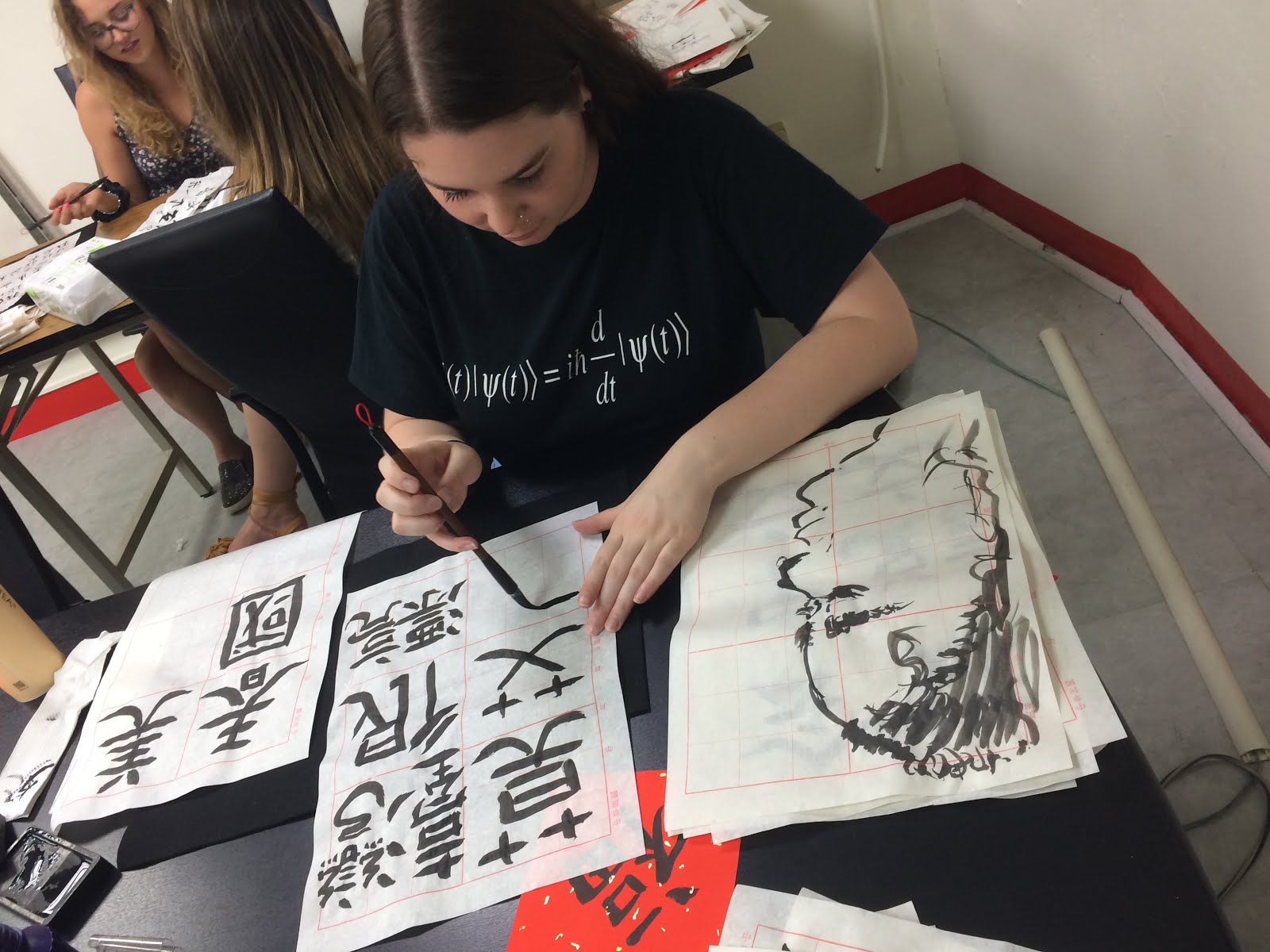
Practicing calligraphy (書法) at the school 


Being forced to actually speak the language to survive is making leaning the language even easier and its great practice. One of the things that I noticed right away is how nice the locals are here. Whenever I order food everyone asks where I am from, why I'm here in Taiwan, and if I mispronounce a tone they will correct it and have me repeat so I can learn. Taipei is a great city filled with history and culture but I've only experienced a fraction of what it has to offer so far. 

Chiang Kai Shek Memorial (中正紀念堂)
The view of Taipei 101 from Elephant Mountain (像山)
(慈祐宮) Ciyou Temple outside Raohe Night Market


Monday, July 10, 2017

Update from Nagoya, Japan! - VLOG


Learning Mandarin Chinese in Tainan, Taiwan

There is no better way to learn a language than through total immersion; sitting in an American classroom for a few hours every week only gets you so far. Therefore, given that I hope to develop professional fluency in Mandarin Chinese, I am quite thankful to have received the Sigur Center Grant for Chinese Language Study in Taiwan.

At present, I am studying Chinese at National Cheng Kung University in Tainan, Taiwan through the American Councils Taiwan Intensive Summer Language Program. Though I have only been in Taiwan for just over two weeks, my Chinese has already improved markedly!

A farm in Taijiang National Park (the outskirts of Tainan).

The best part of my program is the individualized tutoring. Not only do we meet with a professor for a one-on-one session every morning Monday through Friday, each student also has a language partner. Our language partners are local students who have agreed show us around the city and help us practice our Chinese. This individualized tutoring allows me to tailor my language study experience to my specific areas of interest -- policy issues related to China, especially US-China threat perception in the South China Sea. 

Additionally, I am thoroughly enjoying the cultural aspect of my language study experience. I lived in China for three years while growing up, and so culture shock has not been much of an issue here in Taiwan. Rather, the cultural immersion is a welcome return. In particular, it has been quite interesting to discover how cultural differences between the mainland and Taiwan lead to slight variations in their respective versions of Mandarin Chinese.

A temple in Tainan.

Because Taiwan is relatively small, travelling around the island is fairly fast, cheap, and easy. I've already visited Kaohsiung, and I have plans to visit Taichung and Taipei. Moreover, because I took a class about Daoism last semester, I have seized every opportunity to go see local Taiwanese temples -- I have already visited five!

Flying a kite in Kaohsiung.

I look forward to what these next six weeks have in store.

Zachary Haver is a Sigur Center 2017 Asian Language Fellow. A rising sophomore studying at George Washington University's Elliott School of International Affairs, Zachary is majoring in International Affairs with a concentration in Asia and minoring in Mandarin Chinese.


Saturday, July 8, 2017

The Wall: Overcoming Your Insecurities on the Path to Fluency


The Wall

While the process of learning a second language may come easy for some, it can be a great challenge for others. As someone who has been learning Chinese for nearly five years, I can say it has not come easy for me. There have been moments in the process that have made me question my ability to learn, or my overall desire to continue studying the language. I have referred to my own doubts as “the wall.” And I have found that once you recognize what your wall is, you will be better prepared to overcome it.

Most often our frustrations and doubts are the result of comparison. It is likely that you know someone who fluently speaks two or three languages. Or perhaps, you know someone who mastered Chinese in only a couple years. And I am confident we have all seen books, or online training courses that boast fluency in just six months! When I first began learning Chinese I was determined to realize the same success. When six months, and then a couple years had passed and I had yet to achieve anything beyond an intermediate speaking and reading level, I grew increasingly discouraged. Why was I struggling so much when others seemed to be doing so well? Slowly my insecurities began to take over. I was afraid to practice speaking in front of others, afraid they would judge me for my limited vocabulary and poor grammar. This fear and my concern with what others thought of me and my abilities grew, and as it did it began to undercut my learning.

I wish I could tell you this is something that is easy to overcome, but it is not. If you have experienced this yourself, I am sure you understand. Self-consciousness can keep you from utilizing the resources around you meant to promote learning, or make you pass up unique academic or professional opportunities simply because you do not think you have what it takes. My self-doubt prevented me from speaking Chinese with my classmates and other international students. It kept me from registering for courses that utilized primary resources in Chinese. While I was studying abroad in Taiwan four years ago, it caused incredible nervousness when I was merely trying to order a meal. I was absolutely terrified of conversing with anyone in Chinese. My fear grew from a bump in the road to a daunting wall. Fortunately, I have just now made it to the other side of this wall.

When I decided to spend the summer in Taipei studying Chinese, I told myself this was for me. I was taking this opportunity to improve myself and nobody else. Personal improvement is just that, PERSONAL! You cannot and should not measure your success or growth by anyone else’s standards. Everyone learns differently and at a different pace. Whether it takes you months or years to learn a language, be proud of yourself. Always be confident in your dreams, even when you are not confident in yourself. The growth I have experienced in the past month is more than I have had in the year prior, proof that when you commit to yourself and your goals, you can overcome all of the irrational yet intimidating insecurities that have ever held you back.

So, go forth! Make mistakes, but choose to learn from them rather than be discouraged by them. We all stumble and sometimes it takes us a while to get back up, but I promise you will make it over the wall!

加油!

Katelyn DeNap

George Washington University - Elliott School of International Affairs
M.A. Security Policy Studies
Organization of Asian Studies – Vice President
Sigur Center 2017 Asian Language Fellow
National Taiwan University - International Chinese Language Program, Taiwan